As businesses grow, managing operations becomes increasingly complex.
Customer information is stored in one system. Financial data exists in another. Teams use separate tools for communication, reporting, inventory management, and project tracking.
Initially, these systems may work independently without creating major issues.
However, as the business expands, disconnected processes often create inefficiencies, duplicate work, reporting challenges, and limited visibility across operations.
This is usually when business leaders begin asking an important question:
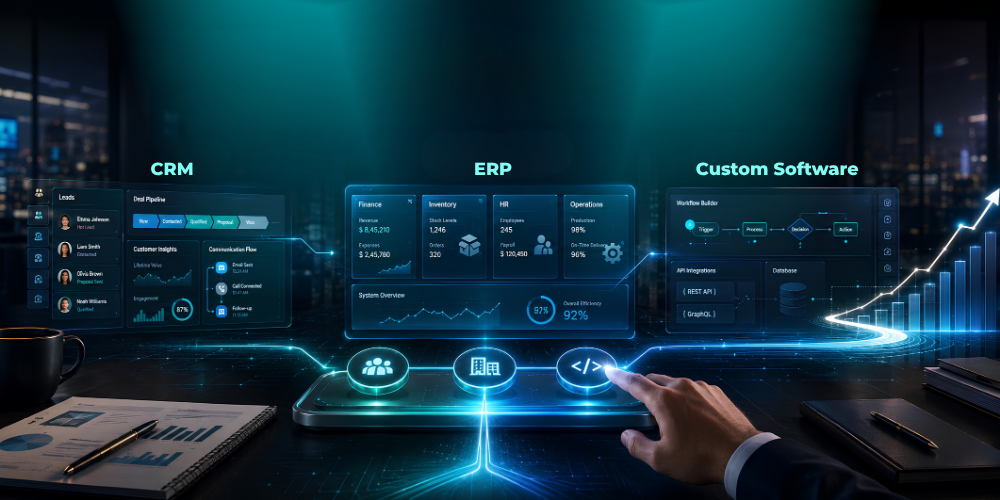
Do we need a CRM, an ERP system, or custom software?
The answer is not always straightforward.
Each solution serves a different purpose, offers different capabilities, and supports business growth in different ways.
Choosing the wrong system can result in wasted investment, operational inefficiencies, and scalability challenges.
Choosing the right system can create a strong foundation for long-term business growth.
What Is a CRM System?
CRM stands for Customer Relationship Management.
A CRM system is designed to help businesses manage interactions with prospects, customers, and clients throughout the sales and customer lifecycle.
The primary objective of a CRM is to improve customer relationships and increase sales efficiency.
Typical CRM Functions Include:
- Lead management
- Sales pipeline tracking
- Customer communication history
- Opportunity management
- Marketing automation
- Customer support management
- Reporting and sales forecasting
Popular CRM platforms include Salesforce, HubSpot, Zoho CRM, and Microsoft Dynamics CRM.
For businesses focused on sales growth and customer engagement, a CRM is often the first step towards digital transformation.
What Is an ERP System?
ERP stands for Enterprise Resource Planning.
Unlike CRM platforms, ERP systems focus on managing internal business operations.
An ERP acts as a central system that integrates multiple departments and business functions into a single platform.
Typical ERP Functions Include:
- Finance and accounting
- Procurement
- Inventory management
- Supply chain management
- Human resources
- Payroll
- Manufacturing operations
- Business reporting
Popular ERP platforms include SAP, Oracle NetSuite, and Microsoft Dynamics 365.
ERP systems provide greater visibility across the organisation by centralising operational data and processes.
What Is Custom Software?
Custom software is developed specifically for a business based on its unique requirements.
Unlike CRM and ERP platforms, custom software is not built around standard business processes.
Instead, it is designed around the way a specific organisation operates.
Custom software can include:
- Custom CRM platforms
- Industry-specific ERP systems
- Workflow management systems
- Customer portals
- Inventory systems
- Business automation platforms
- Internal operational tools
Rather than forcing the business to adapt to software limitations, the software adapts to the business.
CRM vs ERP: Understanding the Key Difference
One of the biggest misconceptions is that CRM and ERP systems are interchangeable.
They are not.
A CRM focuses primarily on customers and revenue generation.
An ERP focuses primarily on operations and resource management.
CRM Answers Questions Such As:
- Who are our customers?
- Where are our sales opportunities?
- What is the status of our pipeline?
- How effective are our sales activities?
ERP Answers Questions Such As:
- What is our inventory status?
- How are finances performing?
- What resources are available?
- How efficiently are operations running?
In simple terms:
CRM manages customer relationships.
ERP manages business operations.
Many growing businesses eventually require both.
When a CRM Is the Right Choice
A CRM system is often the best solution when customer management becomes difficult.
Signs your business may need a CRM include:
- Leads are being managed through spreadsheets
- Sales opportunities are being lost
- Customer follow-ups are inconsistent
- Sales reporting is unreliable
- Customer communication is fragmented
A CRM creates visibility throughout the customer journey and helps businesses improve sales performance.
For businesses struggling with customer acquisition and lead conversion, CRM implementation often delivers immediate value. This is especially important when your website gets traffic but no leads, because the issue is often not just visibility, but how leads are captured, managed, and followed up after the first interaction.
When an ERP Is the Right Choice
ERP systems become valuable when operational complexity increases.
Signs your business may need an ERP include:
- Multiple departments use disconnected systems
- Reporting requires manual consolidation
- Inventory management is difficult
- Financial visibility is limited
- Operational processes are inconsistent
As organisations grow, ERP systems help centralise information and improve efficiency across departments.
This becomes increasingly important for businesses managing multiple locations, larger teams, or complex operational processes.
When Custom Software Becomes the Better Option
Not every business fits neatly into a CRM or ERP framework.
Many growing organisations develop unique workflows that standard platforms struggle to support.
This is where custom software becomes valuable.
Custom Software May Be Suitable When:
- Existing software creates operational limitations
- Unique workflows require specialised functionality
- Multiple systems need deeper integration
- Competitive differentiation is important
- Scalability requirements exceed standard software capabilities
Many businesses discover that while CRM and ERP systems solve certain problems, they also introduce restrictions.
Custom software removes those restrictions by building solutions around actual business requirements. If your business is unsure whether standard tools are enough, it is worth comparing Custom Software or SaaS before making a long-term technology decision.
The Hidden Cost of Choosing the Wrong System
One of the biggest mistakes businesses make is selecting software based purely on cost.
The cheapest solution is not always the most affordable solution.
A system that creates inefficiencies can cost significantly more over time through:
- Lost productivity
- Duplicate work
- Reporting delays
- Poor customer experiences
- Operational bottlenecks
Technology investments should be evaluated based on business outcomes, not just implementation costs.
The real question should be:
Will this system support our growth over the next five years?
The cost of poor systems is not always visible immediately. In many cases, Sri Lankan businesses lose revenue at the final stage because their technology, workflows, and customer touchpoints are not aligned properly.
Why Many Businesses Eventually Use All Three
As businesses mature, many organisations stop viewing CRM, ERP, and custom software as competing options.
Instead, they use them together.
For example:
- CRM for managing customers and sales
- ERP for managing operations and resources
- Custom software for unique workflows and automation
This hybrid approach allows businesses to leverage the strengths of each system while avoiding unnecessary limitations.
The goal is not to replace technology.
The goal is to create a technology ecosystem that supports growth.
Technology should support direction, not replace it. As explored in AI is powerful, direction still comes from people, tools create value only when they are guided by clear objectives, business logic, and long-term strategy.
What Growing Businesses in Sri Lanka Should Consider
Businesses across Sri Lanka are increasingly investing in digital transformation and business automation.
Before selecting a solution, consider:
- What problem are we trying to solve?
- Are our current systems limiting growth?
- Will we need additional functionality in the future?
- How quickly is the business expanding?
- Do we require unique workflows?
Technology decisions should align with long-term business objectives rather than short-term operational challenges.
The right system today should still support the business tomorrow.
This matters because many companies do not fail due to lack of effort. They fail because their systems cannot support the next stage of growth. This is one reason why Sri Lankan SMEs struggle to scale even when teams are working hard and operations appear busy.
CRM, ERP, and custom software all play important roles in business growth.
CRM helps businesses manage customers and sales opportunities.
ERP helps businesses manage resources and operations.
Custom software helps businesses solve unique challenges and create competitive advantages.
The right choice depends on where your business is today and where it plans to be tomorrow.
Successful technology decisions are not based on trends.
They are based on business strategy, scalability requirements, and long-term growth objectives.
Not sure whether your business needs a CRM, ERP, or custom software solution?
MindvisionIT helps businesses evaluate their operational requirements, identify technology gaps, and build systems that support sustainable growth.